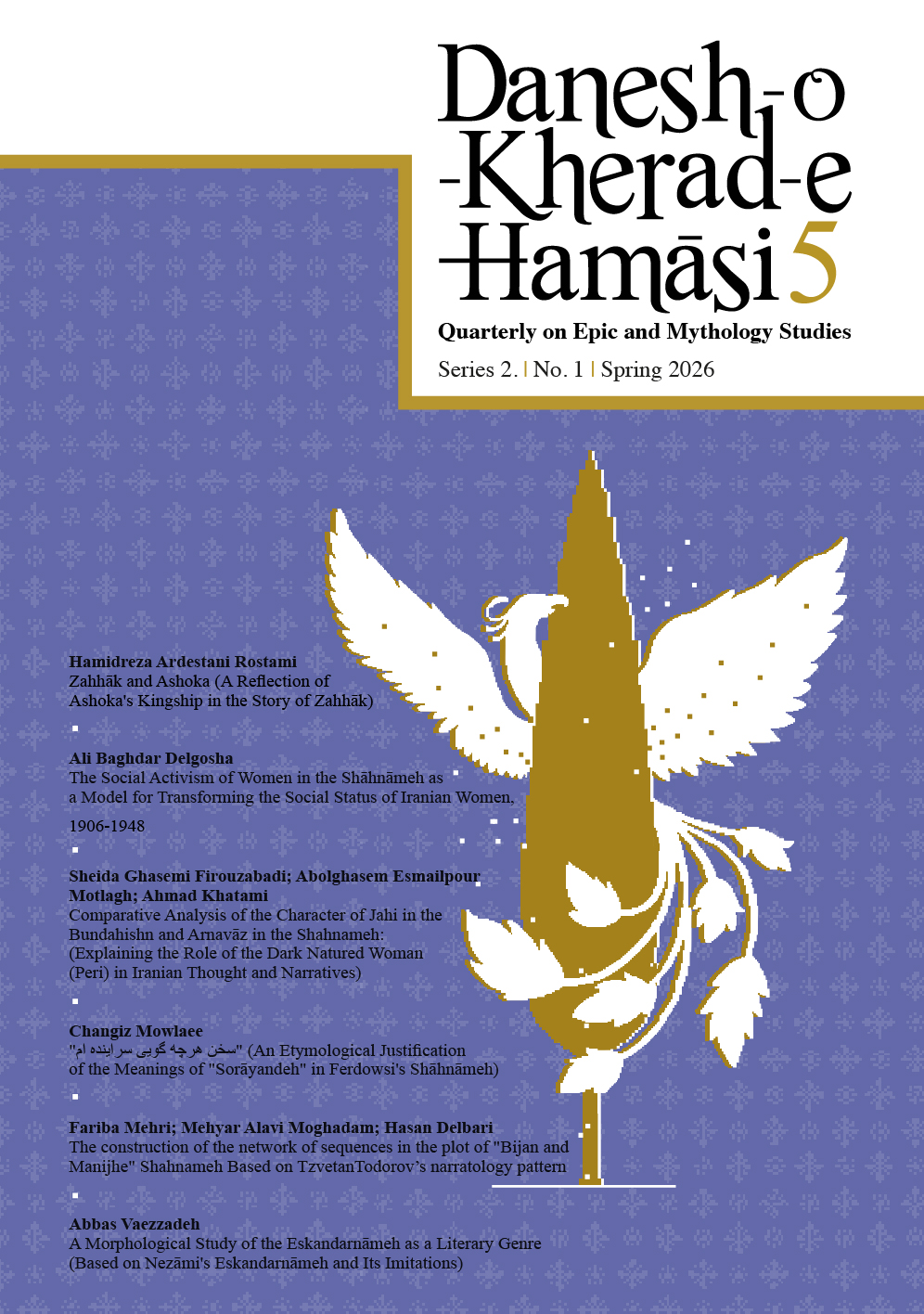
The Social Activism of Women in the Shāhnāmeh as a Model for Transforming the Social Status of Iranian Women, 1906–1948
Document Type : Original Article
10.22067/jmels.2026.99787.1068
Abstract
Employing a documentary method and a descriptive-analytical approach, the present study seeks to examine which narratives of social activism among the women of the Shāhnāmeh were drawn upon to critique social behavior concerning women, from the Constitutional period (1906) to the first decade of the second Pahlavi era. It further asks which women of the Shāhnāmeh, and what forms of behavior, were presented as models for transforming the social status of Iranian women. An examination of women's writings and the women's press during this period reveals that, in the Constitutional era, only three periodicals—Habl al-Matin (1906), Iran-e Now (1909), and Nāmeh-ye Bānovān (1920)—established a connection between social critique, women's issues, and the social activism of the Shāhnāmeh's women. In the Pahlavi era, among the women's press, the periodical Bidāri-ye Mā (1944–1948), adopting a Marxist approach, devoted the greatest attention to the women of the Shāhnāmeh. By narrating the social activism of several of the Shāhnāmeh's women—such as Rudabeh, Tahmineh, and Farangis—it sought to present a perspective that moved beyond the binary of love and social action in the depiction of women within Iran's historical heritage, drawing on Ferdowsi's Shāhnāmeh, and thereby to introduce the social activism of the Shāhnāmeh's women as social models.
. (2026). The Social Activism of Women in the Shāhnāmeh as a Model for Transforming the Social Status of Iranian Women, 1906–1948. Epic Knowledge and Wisdom, 2(1), 27-44. https://doi.org/10.22067/jmels.2026.99787.1068
MLA
. "The Social Activism of Women in the Shāhnāmeh as a Model for Transforming the Social Status of Iranian Women, 1906–1948", Epic Knowledge and Wisdom, 2, 1, 2026, 27-44. doi: 10.22067/jmels.2026.99787.1068
HARVARD
. (2026). 'The Social Activism of Women in the Shāhnāmeh as a Model for Transforming the Social Status of Iranian Women, 1906–1948', Epic Knowledge and Wisdom, 2(1), pp. 27-44. doi: 10.22067/jmels.2026.99787.1068
CHICAGO
, "The Social Activism of Women in the Shāhnāmeh as a Model for Transforming the Social Status of Iranian Women, 1906–1948," Epic Knowledge and Wisdom, 2 1 (2026): 27-44, doi: 10.22067/jmels.2026.99787.1068
VANCOUVER
. The Social Activism of Women in the Shāhnāmeh as a Model for Transforming the Social Status of Iranian Women, 1906–1948. Epic Knowledge and Wisdom. 2026;2(1):27-44 (In Persian). doi: 10.22067/jmels.2026.99787.1068