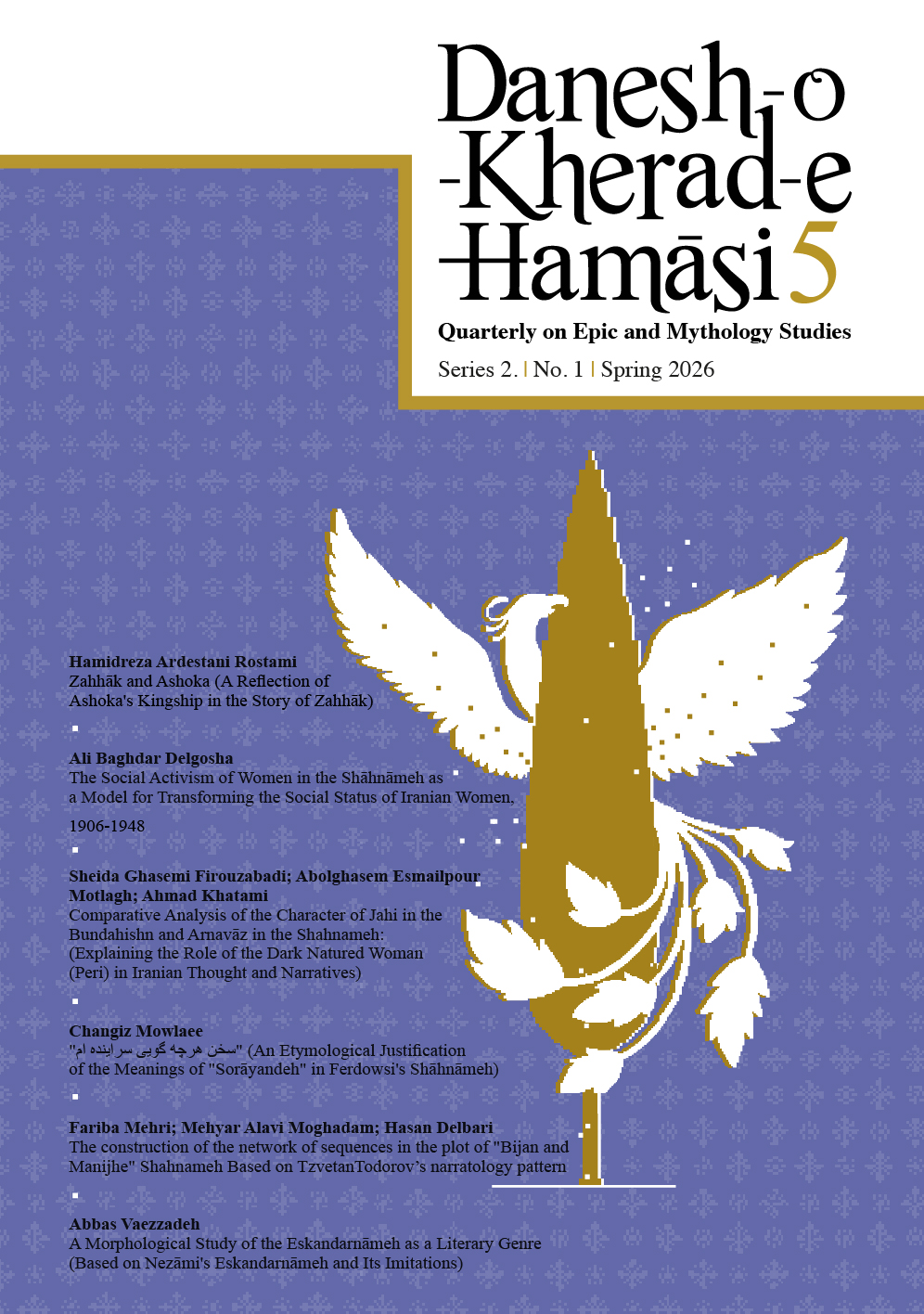
A Morphological Study of the Eskandarnāmeh as a Literary Genre (Based on Nezāmi's Eskandarnāmeh and Its Imitations)
Document Type : Original Article
10.22067/jmels.2026.99785.1066
Abstract
Eskandarnāmehs are prose and verse works in Persian literature that recount the story of Alexander of Macedon (356–323 BCE), also known as Alexander/Eskandar Dhū al-Qarnayn. The first independent verse Eskandarnāmeh was composed by Nezāmi Ganjavi (1141–1209 CE) in two parts titled Sharafnāmeh and Eqbālnāmeh. Following him, numerous poets composed Eskandarnāmehs in imitation of Nezāmi's work. The existence of multiple poems bearing the title "Eskandarnāmeh" or similar names, according to the definition of literary genre as "a group of texts bounded by structural, thematic, and/or functional criteria," indicates the presence of a distinct genre in Persian literature known as the Eskandarnāmeh. Based on this definition, an examination of these works can reveal their shared structure, constituting the structural framework of the Eskandarnāmeh genre. This article aims to identify the structure of verse Eskandarnāmehs based on Nezāmi's Eskandarnāmeh and three of its imitations: Amir Khosrow's Āyeneh-ye Eskandari, Jāmi's Kheradnāmeh-ye Eskandari, and Abdi Beg Navidi's Āyin-e Eskandari. Since Eskandarnāmehs are considered narrative literary works, this study employs Propp's morphological method, one of the most effective approaches for identifying the structure of narrative literary genres. Through a morphological analysis of the four verse Eskandarnāmehs, we conclude that the Eskandarnāmeh, as a subgenre of the "heroic epic" (manzumeh-ye pahlavāni), is structurally a narrative comprising ten functions (the hero's emergence, the helper's action, the acquisition of power, the hero's departure and return, the villain's emergence and destruction, the adventure, and the hero's fate) and three character types (the hero, the helper, and the villain).
. (2026). A Morphological Study of the Eskandarnāmeh as a Literary Genre (Based on Nezāmi's Eskandarnāmeh and Its Imitations). Epic Knowledge and Wisdom, 2(1), 93-104. https://doi.org/10.22067/jmels.2026.99785.1066
MLA
. "A Morphological Study of the Eskandarnāmeh as a Literary Genre (Based on Nezāmi's Eskandarnāmeh and Its Imitations)", Epic Knowledge and Wisdom, 2, 1, 2026, 93-104. doi: 10.22067/jmels.2026.99785.1066
HARVARD
. (2026). 'A Morphological Study of the Eskandarnāmeh as a Literary Genre (Based on Nezāmi's Eskandarnāmeh and Its Imitations)', Epic Knowledge and Wisdom, 2(1), pp. 93-104. doi: 10.22067/jmels.2026.99785.1066
CHICAGO
, "A Morphological Study of the Eskandarnāmeh as a Literary Genre (Based on Nezāmi's Eskandarnāmeh and Its Imitations)," Epic Knowledge and Wisdom, 2 1 (2026): 93-104, doi: 10.22067/jmels.2026.99785.1066
VANCOUVER
. A Morphological Study of the Eskandarnāmeh as a Literary Genre (Based on Nezāmi's Eskandarnāmeh and Its Imitations). Epic Knowledge and Wisdom. 2026;2(1):93-104 (In Persian). doi: 10.22067/jmels.2026.99785.1066