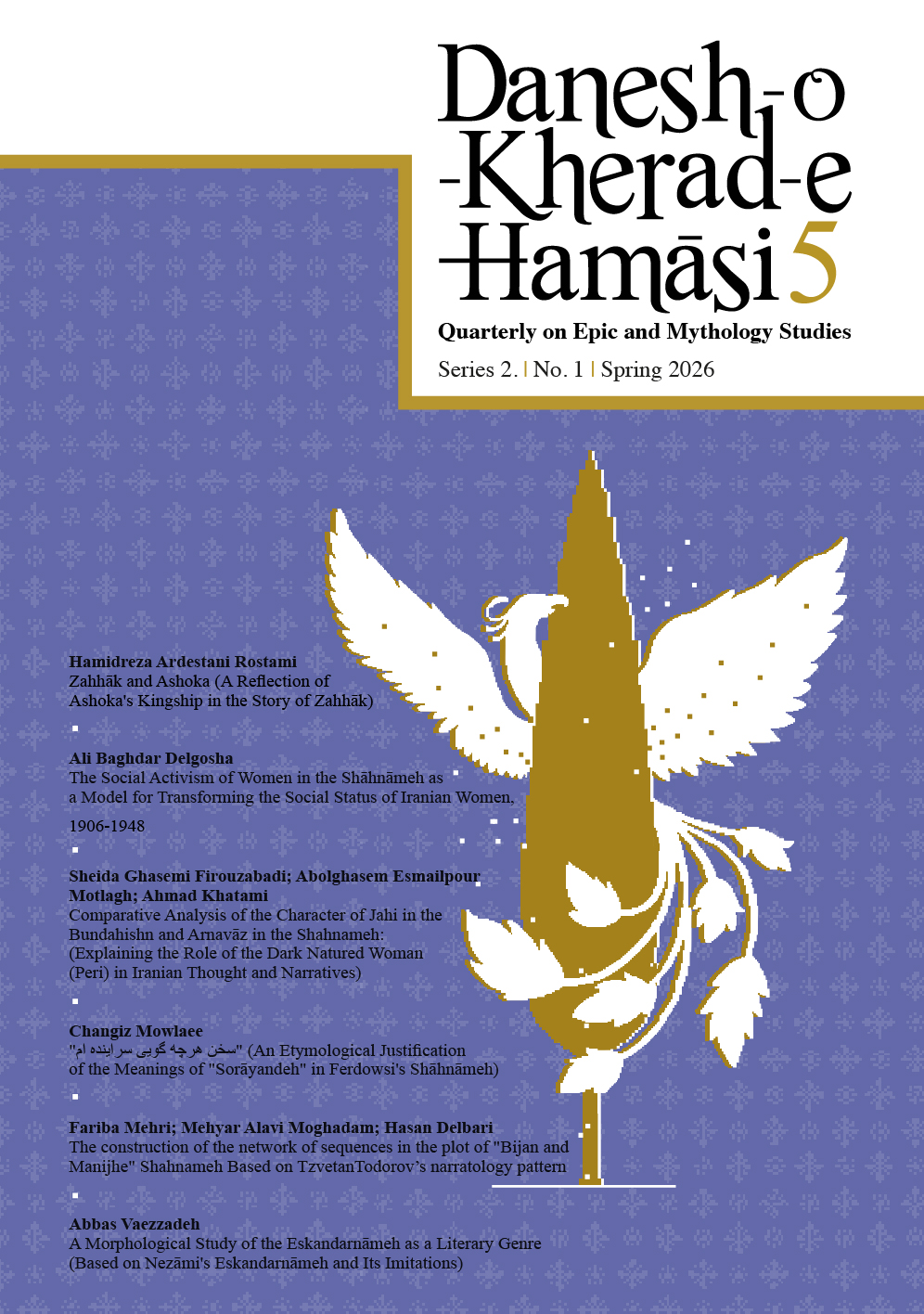
According to Wolff's concordance, the word sorāyandeh appears eighteen times in Ferdowsi's Shāhnāmeh, employed in the following senses: (1) "speaker; narrator, storyteller; poet, versifier"; and (2) "messenger, envoy, courier." A close examination of these verses, however, reveals that in a number of instances, the word sorāyandeh is intended in neither of these established senses. Rather, based on contextual evidence and linguistic considerations, it can be established with confidence that in certain occurrences within the Shāhnāmeh, this word is used in the sense of "obedient, submissive" (i.e., one who obeys or complies). Some scholars have assumed that the use of sorāyandeh in the sense of "obedient, submissive" suggests that the word's original meaning was something akin to "one who repeats whatever is said to him." This justification, however, lacks scholarly grounding and is essentially based on a folk etymology. The present article offers an etymological justification for the use of sorāyandeh in the aforementioned senses. Evidence from Old and Middle Iranian texts demonstrates that the root sru-, originally meaning "to hear," possessed a broad semantic range, one component of which was "to obey; to be compliant."
Mowlaee, C. (2026). "سخن هرچه گویی سراینده ام" (An Etymological Justification of the Meanings of "Sorāyandeh" in Ferdowsi's Shāhnāmeh). Epic Knowledge and Wisdom, 2(1), 63-73. https://doi.org/10.22067/jmels.2026.99788.1069
MLA
Mowlaee, C. ""سخن هرچه گویی سراینده ام" (An Etymological Justification of the Meanings of "Sorāyandeh" in Ferdowsi's Shāhnāmeh)", Epic Knowledge and Wisdom, 2, 1, 2026, 63-73. doi: 10.22067/jmels.2026.99788.1069
HARVARD
Mowlaee C. (2026). '"سخن هرچه گویی سراینده ام" (An Etymological Justification of the Meanings of "Sorāyandeh" in Ferdowsi's Shāhnāmeh)', Epic Knowledge and Wisdom, 2(1), pp. 63-73. doi: 10.22067/jmels.2026.99788.1069
CHICAGO
C. Mowlaee, ""سخن هرچه گویی سراینده ام" (An Etymological Justification of the Meanings of "Sorāyandeh" in Ferdowsi's Shāhnāmeh)," Epic Knowledge and Wisdom, 2 1 (2026): 63-73, doi: 10.22067/jmels.2026.99788.1069
VANCOUVER
Mowlaee C. "سخن هرچه گویی سراینده ام" (An Etymological Justification of the Meanings of "Sorāyandeh" in Ferdowsi's Shāhnāmeh). Epic Knowledge and Wisdom. 2026;2(1):63-73 (In Persian). doi: 10.22067/jmels.2026.99788.1069