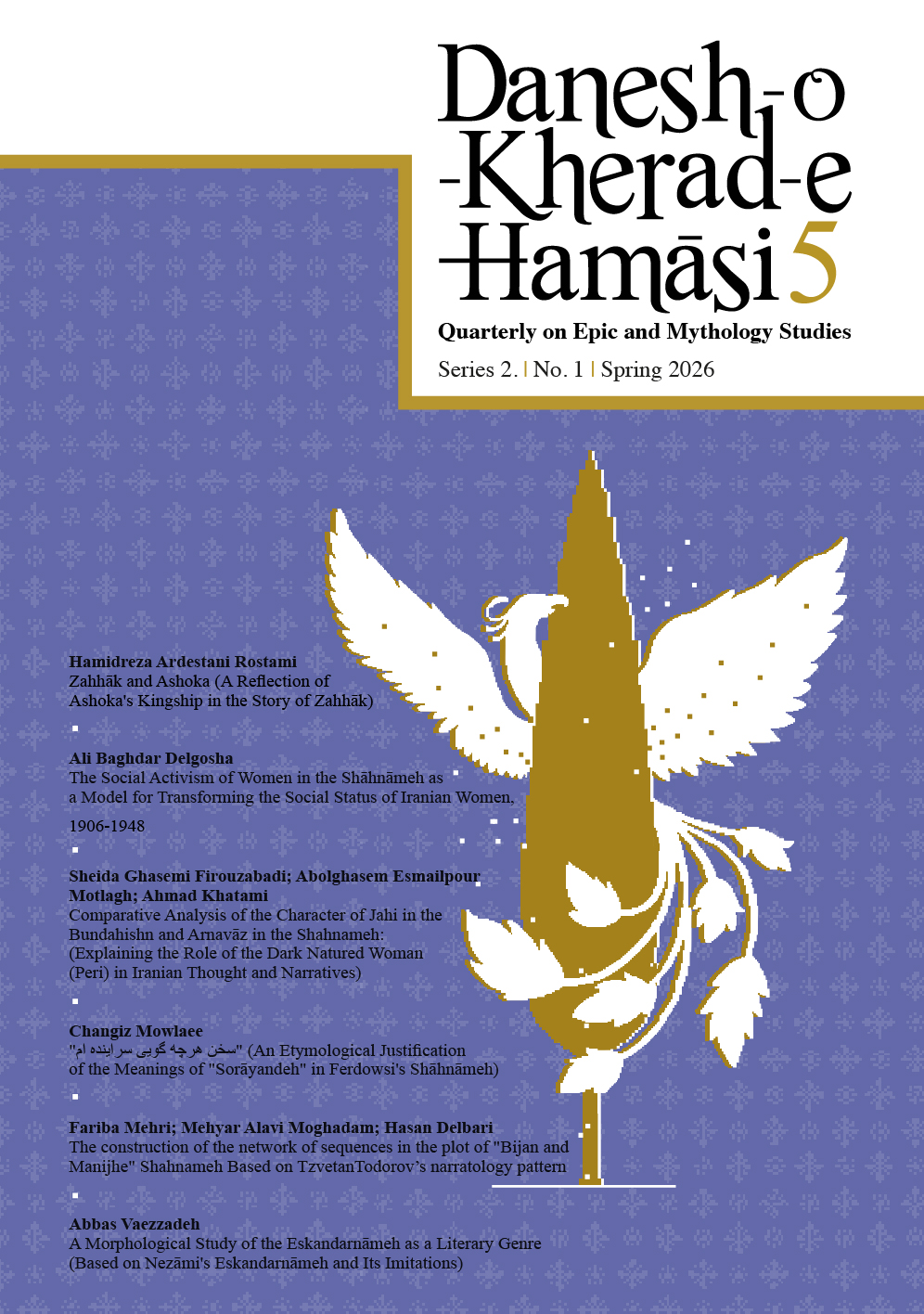
Rostam, the Dawn Sun A Study on the Similarities between Mitra and Rostam

Pages 5-38

https://doi.org/10.22067/jmels.2025.94149.1054

Abbas Azarandaz

Abstract This article explores the parallels between Rostam, the legendary hero of the Shahnameh, and Mitra, the ancient Iranian and Indo-Iranian deity. Drawing on Avestan texts—especially the Mihr Yašt—the author demonstrates that Rostam, as a heroic human figure, embodies the epic representation of Mithra’s attributes and functions. Mithra is depicted in the Mihr Yasht as a warrior deity, guardian of oaths, bestower of xvarǝnah (divine glory), and protector of the Iranian land—qualities that are fully reflected in Rostam’s character. Through historical, geographical, and mythological evidence, the article highlights the eastern Iranian origins of both Mithraic traditions and the Saka (Scythian) roots of Rostam, suggesting the profound influence of Mithraism on the shaping of Iran’s national epic. Although the author does not claim that Rostam is a direct transformation of Mitra, it is argued that his character and stories evolved in a cultural context heavily influenced by Mithraic beliefs. Thus, Rostam emerges as the most prominent epic embodiment of the divine archetype that Miϑra represents.

Re-reading the Shahnameh: Contemporaneity and Fusion of Horizons

Pages 39-58

https://doi.org/10.22067/jmels.2025.94510.1056

Masoud Algooneh Jouneghnai

Abstract This study explores the possibility of reinterpreting Ferdowsi’s Shahnameh in the contemporary era, employing a multidisciplinary theoretical framework to analyze the challenges and opportunities of such a rereading. Drawing on Cassirer’s philosophy, myth and epic are understood as symbolic forms embedded within specific historical epistemes, which poses epistemological challenges for modern readers. Meanwhile, Althusser’s concept of the "problematic" underscores the necessity of reconstructing the ideological and historical conditions of meaning production to fully grasp the text’s significance. By integrating Gadamer’s theory of the "fusion of horizons" and Jameson’s historicism, this research argues that the Shahnameh is not merely a static historical artifact but a living text capable of engaging in a dialectical dialogue with contemporary readers, addressing present-day questions. The findings demonstrate that, despite the epistemic gap between the text’s world and modern readers, hermeneutic and historicist approaches can facilitate a dynamic and creative interaction with the epic. Ultimately, the study concludes that the tension between the text’s historical rootedness and the necessity of modern interpretation is not an obstacle but an opportunity for the continuous reinvention of meaning. As an interpretively open text, the Shahnameh retains its relevance and can contribute to redefining Iranian identity in today’s world.

Jangnameh of Khavanin Kohgiluyeh by Akhund Mulla Nazar Ali, an imitation of Ferdowsi's Shahnameh (Introduction and Criticism)

Pages 59-76

https://doi.org/10.22067/jmels.2025.92690.1044

Seyyed Ali Seraj, ُSeyyed Ebrahim Raigani, Hossein Rahad

Abstract The context of the geographical location of Kohgiluyeh and Boyer-Ahmad province is based on tribal relations. In this province, the head of each tribe is addressed with the title of "Kay". Due to the privileged position that Ferdowsi's Shahnameh has had among the people of this land, the pattern of behavior, tribal and class relations has been adjusted based on the stories of the Shahnameh and various works in poetry and prose have emerged in this field. The epic work "Jang-nama Khavanin Kohgiluyeh" is a poem by Mullah Nazar Ali, following Ferdowsi's Shahnameh, about the type of thinking of the people of that time, the policy of the ruling system, the economic situation, the type of taxes, the way the rulers were chosen. The manuscript of this war letter was written in the years 1318 to 1323 AH by Mohammad Ibrahim Akhund Mulla Nazar Ali. The importance of this war letter can be traced to the influence of meter, the epic style of the Shahnameh, the use of the structure of the stories of the Shahnameh in the narration of local wars, and the use of local vocabulary. In addition to the literary and narrative values of the work, the problems of rhythm and rhyme, grammatical errors, weakness of authorship and mistakes in the structure of words, have reduced the eloquence and expressiveness and consequently the beauty of the words.

The Shahnameh Recitation Ritual and Shahnameh Reciters in Baft County in the Last Hundred Years

Pages 77-102

https://doi.org/10.22067/jmels.2025.93894.1051

Davoud Soltaninejad, Hamid Reza kharazmi, Hamed Hosseinkhani

Abstract Ferdowsi's Shahnameh is one of the prominent poetic works of Iran in the fourth century, which played a significant role in the growth and expansion of Iranian culture and has been of great interest throughout Iranian history, especially in the present day. One of the most telling and obvious signs of cultural identity formation is the Shahnameh reading gatherings, which, in addition to introducing different generations to this valuable book, are also considered a valuable model in behavior, character, ethics, etc. The purpose of this article is to introduce the tradition of Shahnameh reading and Shahnameh readers in the city of Baft in the last century. Baft is a mountainous region with a population of more than ninety thousand people, located in the southwest of Kerman. The four-season climate, rivers, mountainous structure, and extensive pastures have provided the basis for the entry of various Iranian tribes and tribes into this region. Since the era of the Seljuk kings, when the first nomadic groups were engaged in animal husbandry, and also among the natives of the Baft region, whose occupation was agriculture, "Shahnameh reading" has been widespread and widespread among the people of this region, and the authors of this research have attempted to collect their names and places in the last century through fieldwork.

Representation of Rostam's helmet during the development, prosperity and decline of Iran's book design ages (Case study: Shahnameh Tahmaspi)

Pages 103-124

https://doi.org/10.22067/jmels.2025.93008.1046

Vahideh Karimian, Farzaneh Farrokhfar

Abstract Rostam is the most important warrior and one of the most significant characters of epic literature in Ferdowsi's Shahnameh, a significant part of this epic includes descriptions of his appearance and stories, which have been the basis for Iranian illustrators to create many images. Shahnamehs of Baysangri, Tahmasabi and Davari, in addition to having many and significant paintings, are considered to be the most important works of painting schools, which belong to the periods of development, prosperity and decline of Iranian painting, respectively. Therefore, the study of these Shahnamehs has been considered in this research. Among the weapons, Rostam's helmet has the ability to be investigated more due to its diversity in content and image. The question is: what visual characteristics have the authors of Shahnameh Baysangri, Tahmasabi and Davari shown in the drawing of Rostam's helmet? The results of the research show that during the development period, attention to the literary text of the Shahnameh was considered by the artist; but from this time onward, under the influence of the artist's imagination, the decorative and representational aspects of Rostam's helmet have become stronger and less follow the narrative.

Study and analysis of elements related to Ayyari culture in ancient Borzunama

Pages 125-148

https://doi.org/10.22067/jmels.2025.90281.1036

vahid mobarak

Abstract Analysis of normative elements in the ancient Borzunamah
Abstract
The ancient Borzunameh, with the theme of the war between father and son (battle with relatives), is one of the additional stories of the Shahnameh with a structure similar to the story of Rostam and Sohrab, which was composed (from 570 to 680 AH) by Shams al-Din Mohammad Kusaj (Kuseh) and has two parts: the birth, battle, and captivity of Borzu (Sohrab's son) with the Iranians, and the second part is the battle, Pilsom, and Susan Rameshgar with the Iranian heroesThe findings of this descriptive-analytical study of the Borzunamah show that this work includes some elements and elements of the epic, such as making the agricultural class a hero in comparison with the ancient heroes; simulating and linking it to the epic of Sohrab; the weakness of the causal relationship; not observing the chastity of words and actions; the hero's truthfulness and honesty; rebuilding social institutions, justice, and security destroyed by the invasion of foreigners; self-interest and strengthening Iranian nationalism; abandoning the idea of the supremacy of the monarchy by showing their weakness and emphasizing the populism of the nobles and the people of Fatwa; religious and religious tendencies; patriotism; linguistic and structural weaknesses and simplicity and fluency of language; and the depiction of the life of the urban middle class and the professional community, from which most nobles emerged, all of which make the Borzunamah a link between epic and history, and the texts of the nobles and epic.

On the name of Garsivaz and Afrasyab in Farsi and Pahlavi

Volume 1, Issue 1, Spring 2024, Pages 99-112

https://doi.org/10.22067/jmels.2024.84616.1010

Abstract About most of the propre names of Firdowsi’s Shahnama one can find numerous information in previous literature, especially in Namenbücher and entries of encyclopaedias. We know the origin of many of these names, but we do not always know, or previous scholars have not shown with precision, in what way and through which changes these names reached the Arabic and Persian texts, in our cases Shahnama. Garsīvaz and Afrās(i)yāb are among these names. Although their origin in the Avesta is known, it is not known why they occur in these forms in the Shahnama and/or some other Farsi, Pahlavi and Arabic texts. In this paper, the author tries to collect and analyze the different forms of these two names in Pahlavi, Farsi, and Arabic texts and investigate the causes of their phonetic changes to finally find out why the names Garsīvaz and Afrās(i)yāb reached the Shahnama in these to not totally natural forms.

Rudaki and Kalila and Dimna

Volume 1, Issue 3, Autumn 2024, Pages 37-52

https://doi.org/10.22067/jmels.2025.92569.1043

Abstract More than a thousand years have passed since Rudaki, the great Persian poet, rendered Kalila and Dimna into verse during the Samanid era. Unfortunately, only a small number of scattered verses from this invaluable work have survived. The remnants of this poetic adaptation exist as dispersed verses recorded in various literary and historical texts, as well as poetic lexicons. Based on this limited corpus of surviving verses, alongside weak contextual clues and uncertain hypotheses, some scholars—and before them, an Orientalist—have suggested that Rudaki versified only a portion of Kalila and Dimna.

The present study seeks to critically examine this claim and, by drawing on available sources and evidence, argue that Rudaki in fact rendered the entire Kalila and Dimna into verse. Furthermore, this study highlights the high regard in which Rudaki was held for this remarkable achievement in his time, as well as the widespread fame he attained throughout the Persian-speaking world of that era due to his poetic rendition of this esteemed text.

The beginning of the Sassanids in Shahnameh; from Ardashir to Bahram III

Volume 1, Issue 2, Summer 2024, Pages 27-44

https://doi.org/10.22067/jmels.2024.86387.1018

Abstract This article tries to take a quick look at Ferdowsi's narrative from the beginning of the Sassanids to the end of Bahram III's reign and its values and shortcomings by using historical sources and Sasanian studies. Ardashir's narrative is detailed and legendary due to his power, legitimacy, territorial integrity, the union of religion and the state, his founding, and the necessity of genealogy and transmission.Shapur I was a policy consolidator and has a relative importance, but it has faded under the shadow of his father and Shapur II. Hormazd I and Bahram have the least number of narrations in national traditions. The shortness of the kingdom, the namesake of several Hormazds, the namesake of sevral Bahrams and the mixing of data, the lack of interesting narratives and the presence of Shapur II after them are the reasons for this lack of importance. In these sections, the Shahnameh has detailed sermons, admonitions, and commandments, most of which have been deleted. These sections are rich in Iranshahri political philosophy and ethics. In general, the narrative of Shahnameh is a historical narrative with idealistic, moral, heroic and literary attitudes, but Ferdowsi's trustworthiness and transmission of historical and narrative data have increased the historical and narrative value of the text.

Considerations about the nature of Fereydoun's sin

Volume 1, Issue 1, Spring 2024, Pages 71-98

https://doi.org/10.22067/jmels.2024.83656.1007

mahmoud rezaei dasht arzhaneh

Abstract The guilt of Fereydun, one of the greatest Pishdadi kings, is mentioned in Mainyō-ī Khard and the Pahlavi narrative alongside Jamshid and Keykavus, although there is no indication of his guilt in the Shahnameh. In this essay, after criticizing the previous views on this matter, two hypotheses about Fereydun's sin have been proposed: one is considering that the Vedic counterpart of Zahhak, Vishurupa, a three-headed, three-faced and six-eyed dragon, in the Mahabharata, is a devout and religious Brahman who continuously recites the Vedas with one head, and Indra, fearing that he might take his place among the gods, kills him and because of this sin, loses the dominion of the sky and his strength decreases, it could be that Fereydon's sin is also connected with killing Zahhak; who is also a worshiper in disguise of Mardas and also vowed and sacrificed to Anahita and Wayo, still has signs of his Brahminism and religion in the Shahnameh. On the other hand, considering that Indra's other sin, is the seduction of Ilya/Ahlia, a Brahmin woman named Gautmahnam, and as a result of this sin, Indra loses all his beauty and it is transferred to two Nasitiyas, it is not unlikely that Feridun's other sin was kidnapping two Brahmin women. A matter that has been elegantly depicted following the fundamental Post- Zoroastrian transformations.

The Mazdakites, the ʿAyyārs and the Mithraists

Volume 1, Issue 1, Spring 2024, Pages 113-133

https://doi.org/10.22067/jmels.2024.85566.1016

Abstract No revolutionary movement in Iranian Late Antiquity has attracted as much attention as the fascinating and enigmatic Mazdakite uprising of the late fifth century. The scholarly consensus about these has it that 1) they engaged in ibāḥat al-nisā, sharing of wives; 2) advocated the sharing of property and 3) that their past time was wine imbibing and merrymaking. I shall argue here that, as Shaki correctly suspected but did not pursue the topic, the description of the Mazdakite in our primary sources (the Letter of Tansar, Ibn Qutayba, Ṭabarī, Dīnkard, Shahrestānī), actually follows the praxis of the ʿayyārs, chivalrous men and women who practiced celibacy, lived together in communes of men and women, usually in underground cities, and drank wine as part of their sacral ritual. The detractors of the Mazdakites heaped on these accusations that distorted their realities, realities that on a populist level, and in times of crisis of the late fifth century might have in fact devolved into a distortion of the praxis of genuine Mithraists as well. That they continued, appropriate to their praxis, in the form of Khurramdīn movements is also part of their story. That they were launched as collaborators of the Parthian Mehrānids (notice the name), against the Parthian Kārenids who were suffocating the young Kavād during the last decade of the fifth century is also part of their fascinating history.

On the Distinction Between the Two Mythical Dynasties of Iran

Volume 1, Issue 3, Autumn 2024, Pages 97-106

https://doi.org/10.22067/jmels.2025.93648.1050

Abstract Various theories have been proposed regarding the differences between the two mythical dynasties of the Pishdādians and the Kayanids, as well as the reasons for their separation. At first glance, given the genealogical connection between the Kayanid and Pishdādian kings, such a division may appear redundant. Even those Iranian mythologists who argue that the Kayanid kings were less endowed with mythical attributes compared to the Pishdādian rulers have, in practice, acknowledged that most Kayanid kings do indeed possess mythical qualities, and thus have failed to present conclusive evidence to support their claim. It seems that the primary reason for the distinction between these two groups of Iranian mythical kings lies in their differing roles: the Pishdādian kings independently embodied both the functions of kingship and heroism, whereas the Kayanid rulers retained the function of kingship for themselves and delegated the heroic function to champions such as Garshāsp, Zāl, and Rostam.

The Child of the Demon; Another Reflection of the Birth and Rejection of Zaal

Volume 1, Issue 2, Summer 2024, Pages 45-70

https://doi.org/10.22067/jmels.2024.88626.1030

Abstract Ferdowsi's Shahnameh is replete with overt and covert mythological themes that have either vanished or undergone significant transformations, rendering their comprehension a complex endeavor requiring contemplation and, at times, recourse to informal cultural domains. The Shahnameh employs artistic forms and literary devices, such as metaphors, allusions, and symbols, to convey certain themes, beliefs, and associated customs. Consequently, limiting these expressions to their artistic context hinders a deeper understanding of their underlying meanings. The term "بچۀ دیو" (child of the demon), employed to describe Zaal's unusual birth and subsequent rejection, exemplifies such expressions. This study adopts a descriptive-analytical approach, employing content analysis to unravel the hidden meanings and mythological beliefs associated with the concept of "بچۀ دیو". The findings suggest that the perception of Zaal as an evil entity stemmed from the belief that he was either switched with his doppelganger or that Ahriman, the embodiment of evil, had a hand in his birth. Consequently, he was ostracized from society to either eliminate him or, through a complex and symbolic process, allow the true Zaal to reclaim his rightful place and return to society, thereby safeguarding the nation and lineage from the harm of demonic and malevolent forces.

Publication Information